


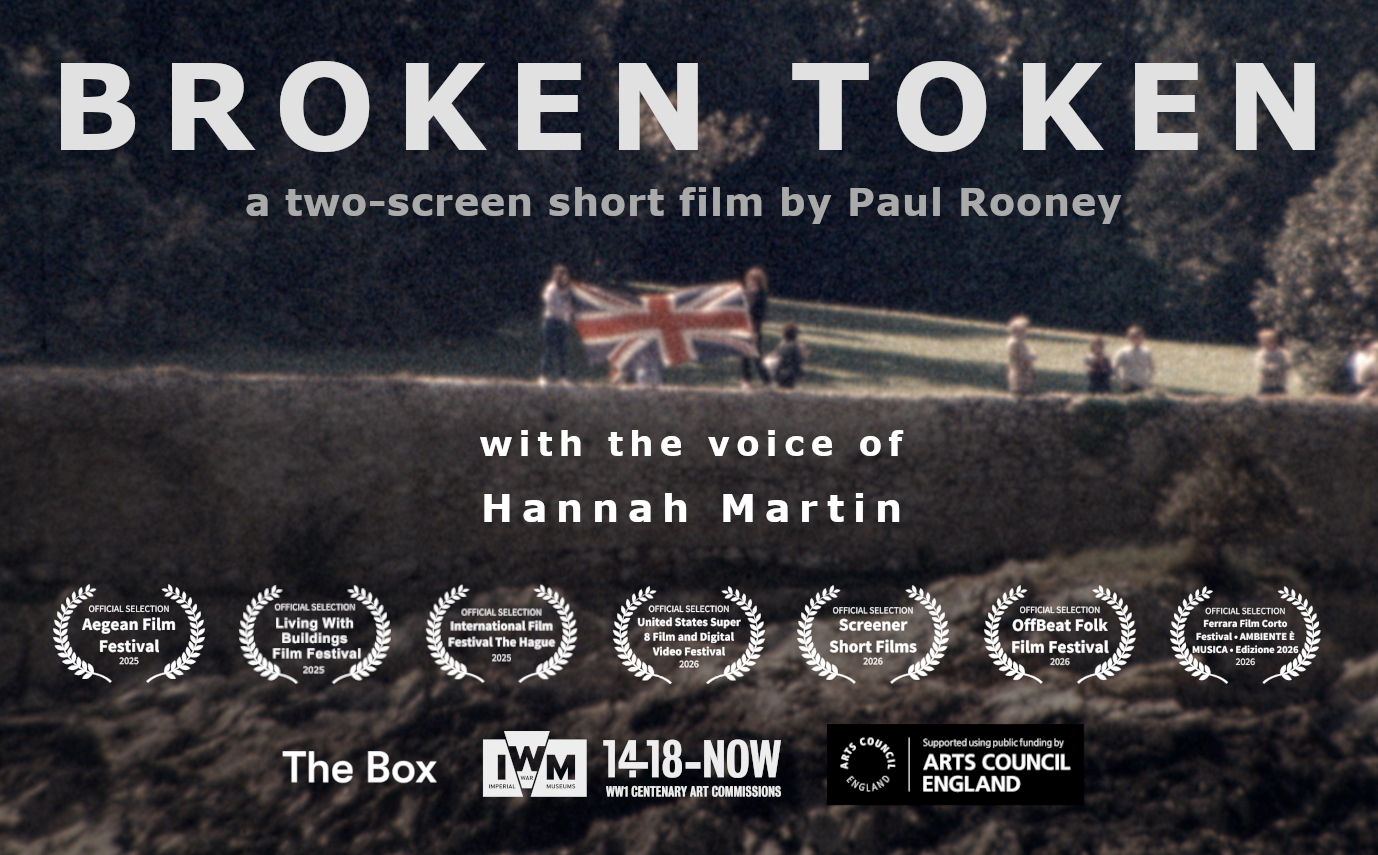
Broken Token trailer
Broken Token full version
Paul Rooney: Broken Token, the ‘making of’ documentary
Broken Token
5.1 channel sound work with two-screen film (Super 8mm/16mm/digital video), 12 mins, 2024.
A single female voice sings a folk ballad, inspired by a song found in a Victorian song collector’s manuscript in a Plymouth, UK, museum archive. She sings of waiting, in her summer garden, for the return home of her love from the war. As she waits, three veterans pass, and she asks them: “When you were fighting in distant lands, did you think of the home you had left?” In reply to this, the veterans tell of their experiences of connecting with home during the conflicts in The Falklands, The Gulf and Afghanistan. These words are taken from interviews with UK ex-servicemen and their family members.
Accompanying the singing voice on two screens are Super 8mm shots of Plymouth summertime front garden gates, thresholds to the archetypal English plot, revealing through their repetition the quiet unpredictability of the ordinary. Each shot is split in two like the ‘broken token’ mentioned in the song (a gimmel ring split between the lovers before he left for war, to be re-united when, or if, he returns). The garden shots (and the voiceover) are disrupted by references to these interviews being recorded, and to the other means that have been used to construct the piece, means by which the past has been made to return anew: searching internet archives; attempting to decipher a manuscript in a museum collection; note taking by a Victorian song collector.
The garden images represent ‘home’, but they also stand in for a more general possibility of redemption, of the potential of the past to return, changed, to renew the present: “Each moment of time is a garden gate,” the song goes, “Through it my love may walk.” The ‘past’ that the veterans experienced, and it’s return to the present in a new form – the veterans’ recollections – are two different things: like the real and its representation, like home and elsewhere, like the two parts of a broken ring. There is a distance between our past and our memories of it now, but knowledge of this allows us to move between them, making the past active in the present, transforming both: “The shining, strange, veiled and broken past/Will upset our world any second now.”
An IWM 14-18 NOW Legacy Fund commission, in partnership with The Box, Plymouth. Many thanks to the group of Plymouth veterans and families involved: Tony, Carol, Yorkie, Chris and Aden. Thanks to Imperial War Museum, and all at The Box, Plymouth: Tony Davey (Engagement Officer), Jodie Bishop (Public Art Officer), Claire Skinner (Archivist), Terah Walkup (Art Curator), Stacey Anderson (Media Archivist), James Gibbs (Media Technician), and Oliver Williams (Media Technician). Thanks to Scott Rooney, John Salim.
Colin R Greenslade. This 26: Contemporary Scottish Art and the Academy publication. Royal Scottish Academy. 2026 article referencing the work.
Editors (The Lincoln Review Issue 6). Summer 2025 publication in literary journal of the poem Broken Token (based on the Broken Token script).
The News Desk (ArtRabbit website). 26/11/2024 feature article referencing the work.
Jo Clarke (Plymouth Herald newspaper). 12/11/2024 feature article about the work.
Louis Chadwick (Plymouth Chronicle). 7/10/2024 article referencing the work.
The News Desk (Artists and Illustrators magazine). Oct. 2024 preview of the work.
Imperial War Museum Oct. 2024 webpage about the work.
The News Desk (Devon Daily website). 10/4/2024 article referencing the work.
The News Desk (Visit Plymouth website). 2/4/2024 article referencing the work.
Credits:
Image and sound editing – Paul Rooney
Music – Paul Rooney, incorporating ‘The Broken Token/Dark Eyed Sailor’ folk song tune (anonymous)
Words – Paul Rooney incorporating ‘The Broken Token’ folk song (anonymous) and interviews with Tony, Carol, Yorkie and Chris with help from Aden.
Singer – Hannah Martin
Violin – Hannah Martin
Shruti box – Phillip Henry
Voice recording – Phillip Henry
Super 8 cameraman and colour grading – Dan Paolantonio
Super 8 film processing – Andec, Berlin
Exhibition screens – Paul Ager